A compact, car-free itinerary with castle views, riverside architecture, Slovenian food and room for changing autumn weather.
A small capital worth slowing down for
Ljubljana is an appealing autumn choice for travellers who want a city break with a strong outdoor element. The centre invites repeated short walks along the river, while the castle hill and Tivoli provide a change of perspective without requiring a road trip. Three days are enough to discover these different settings, eat leisurely meals and absorb the city’s architectural character. This guide keeps the focus on Ljubljana itself rather than treating it as a brief stop on the way to Slovenia’s lakes.
The seasonal advantage is flexibility: use the clearest half-day for a hill or park and place a museum or a long lunch into a wetter interval. Do not book the trip solely for guaranteed autumn colour. Leaves and light vary, and a grey morning need not ruin a riverside city. The tourism office’s autumn walk suggestions provide useful ideas for choosing a green route close to the centre.
Where to stay and how to arrive
Choose a central base near the river if your priority is walking between cafes, bridges and the old town. Before reserving a historic building, ask about lifts, stair access and the distance from the nearest vehicle drop-off. A property described as central may sit in a pedestrian area; that can be pleasant once settled but matters when carrying luggage. Travellers arriving by train or intercity bus may prefer the area between the station and centre, provided they check the room location and evening noise.
Airport transfers require a separate plan. Compare the current public-bus schedule with your flight arrival and your accommodation location, rather than choosing on the advertised fare alone. Allow a margin for baggage and a later connection if your flight is delayed. For a late arrival, request the total transfer price and destination directly from the transport provider. No fixed airport fare is quoted here because the operator and service selected affect the price.
For the itinerary below, a car adds little. Spend your first afternoon learning the centre on foot, then use transport for a specific longer journey if needed. Walking estimates should include stops, crossings and weather. Keep your luggage storage or hotel check-in arrangements clear before committing to an attraction immediately after arrival.
Four places that explain Ljubljana beyond the postcard
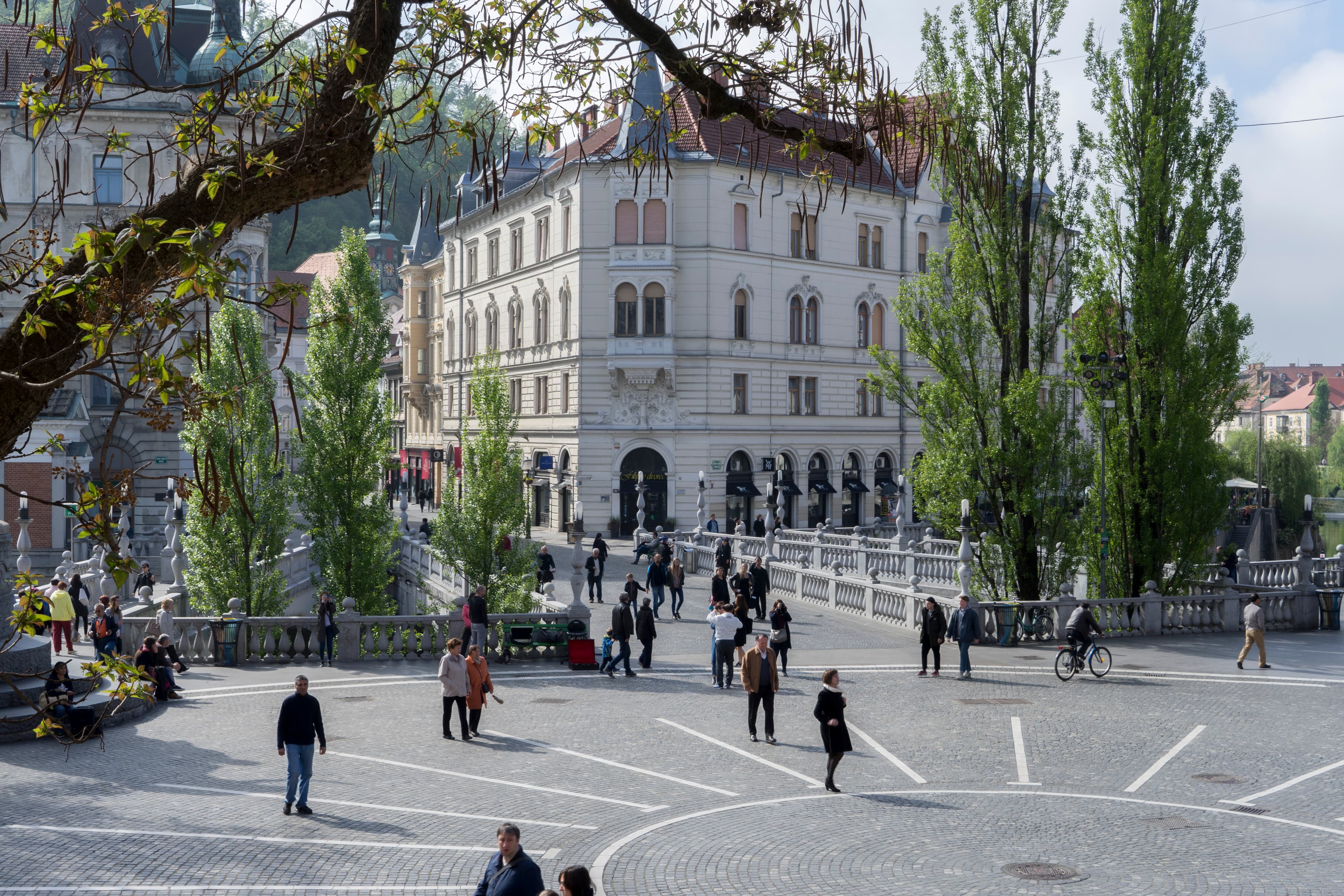
Triple Bridge and Prešeren Square. Use the square as a navigation anchor rather than a quick photo stop. The crossings help you move between the modern centre, market side and old-town riverfront without repeatedly taking the same route. Observe the change from a broad public meeting space to narrow streets and waterside terraces. Return once in the evening if the weather is comfortable: revisiting a place is a useful way to understand a compact capital, particularly when the day’s first visit was busy.
Dragon Bridge. Add it to the market morning, before or after browsing. The official attraction description dates the bridge to 1900–1901 and identifies its reinforced-concrete structure and Art Nouveau decoration. The dragons are the obvious subjects, but the lamps and balustrades deserve a look too. Allow 15–20 minutes for an ordinary sightseeing stop, an editorial estimate rather than a formal visit duration. Keep clear of traffic and do not confuse it with the pedestrian atmosphere around Triple Bridge.
The market arcades. Look at them as architecture as well as a place to buy food: the repetition of sheltered spaces beside the river creates an everyday public route. Compare an indoor section with the outdoor stalls, then choose something to eat rather than treating the whole complex as a museum. An early visit allows you to see trading activity before moving to the nearby castle funicular. Different stall hours explain why a late-afternoon arrival can feel much less lively even when parts of the complex are technically open.
Castle hill. The hill is useful for reading the scale of the centre and its surrounding landscape. Choose the actual castle experiences before buying a bundle: a panoramic outing, a guided history visit and a museum-focused afternoon are different plans. If visibility is poor, the outdoor viewpoint alone may not justify the effort that day; move the visit to the next morning or choose an interior-led ticket. Confirm what remains accessible without a paid attraction ticket rather than assuming every room or tower is freely entered.
Follow Plečnik from the centre to his home
A themed walk gives the third day more substance than simply “walking south”. Begin at the river near Triple Bridge, continue towards the Cobblers’ Bridge area, then turn towards the National and University Library and Križanke before heading on to Trnovo. Use a map for the precise street turns and treat the route as an architectural walk with stops, not a direct transfer. The tourism office’s city guide identifies these buildings and public spaces as part of Plečnik’s contribution. Their relationship to daily city life is the attraction: bridges, education, performance spaces and residential streets belong to one urban story.
The decisive addition is Plečnik House at Karunova 4–6. Its operator lists Tuesday–Sunday opening of 10:00–18:00 and Monday closure. The original home is accessible through an hourly guided visit for a maximum of seven people, with the final tour at 17:00. Standard adult admission covering the exhibition and home tour is €12; exhibition-only entry is €8. Booking online is recommended. This is a meaningful choice, because arriving between tours with no remaining places may prevent you from seeing the home itself.
Allow roughly 90 minutes at the property as a planning allowance, including the exhibition and waiting for your slot. Schedule a 14:00 or 15:00 visit after a central lunch if that suits the day’s availability, and reach Trnovo comfortably beforehand. The small tour size makes the booking more consequential than the walk leading to it. If your third day is Monday, move the house visit to day two and use Monday for the outdoor themed route.
Do not assume library reading rooms or event spaces operate as walk-in tourist interiors. Look at public facades and approach permitted entrances respectfully, following the building’s current visitor rules. The same applies to photographs in a working institution. A complete architectural day does not require entering every building; the home tour is the focused interior that helps the streets make sense.
A specific rainy-day option: the National Gallery
Choose the National Gallery of Slovenia when you want a substantial indoor visit near the central museum area. The official schedule is Tuesday–Sunday 10:00–18:00, with Thursday opening until 20:00; Monday is closed. Last admission is half an hour before closing. Standard adult admission to the permanent collection is €10, while a combined permanent-and-temporary ticket is €14. The first Sunday of each month provides free admission to the permanent collection. Read the precise ticket scope before assuming an exhibition is included.
Set aside 90 minutes to two hours for a selected visit, rather than using the gallery only as somewhere to stand until the rain stops. Decide whether your interest is in a broad collection visit or a named temporary exhibition, and read the programme before choosing. If you are following the Tivoli morning, this can become the day’s indoor anchor, with the outdoor part shortened to match the weather. On a wet Monday, this plan does not work: move museum time to an open day and keep Monday for a sheltered meal and brief walks.
Large bags and coats must go into the self-service cloakroom under the gallery’s visitor rules. That makes it sensible to leave travel luggage at the hotel rather than arrive between a train and check-in expecting unrestricted access. Families should check the activity programme and language of any workshop separately; a scheduled event can offer a different experience from an ordinary ticket. For access requirements, use the gallery’s dedicated accessibility information and confirm any assistance before travel.
How city buses work: the transfer detail that saves confusion
The dated LPP fare table effective from 1 October 2025 lists a one-zone single fare of €1.50. With credit on an Urbana card, that fare includes transfers within 90 minutes. A contactless Visa or Mastercard single ride is also listed at €1.50, but does not include those transfers. Recheck the current tariff before travelling; the distinction between payment methods is more useful than remembering the price alone.
For a visitor who takes one bus to a destination and walks back, bank-card payment may be convenient. For someone changing buses on a longer journey, compare the Urbana arrangement first. Do not apply a one-zone city fare automatically to an airport transfer or regional journey. Check the actual route, zones and operator, and validate according to the chosen payment system. For two people, ask how to pay correctly for both passengers rather than assuming one tap covers a companion.
The official arrival guide confirms a regular public bus linking the airport with Ljubljana’s central bus and railway station. Check a dated departure through the operator before choosing your flight-day itinerary. The city bus payment examples above concern local journeys and are not a substitute for that airport-ticket check. If your hotel is in a pedestrian street, identify the final walking stretch and where a prebooked driver can legally drop you off.
A timed plan with room for lunch
Day one, 09:00–12:00: market breakfast, Dragon Bridge, the arcades and Triple Bridge. Keep the route compact: allow about 60–90 minutes for food browsing, then another hour or more for architecture and photographs. Lunch around 12:30 leaves the afternoon for the old town and a riverside cafe. A two-hour unstructured interval is useful here because the day’s best discovery may be a small street or shop, not another attraction reservation.
Day two, 10:00–13:00: castle outing by funicular or a suitable walking route. Lunch back in the centre, then choose the National Gallery for an art afternoon or a shorter Tivoli stroll for a clear day. If you want both, make the park a brief walk and check the gallery closing time. Do not choose a 17:30 arrival and expect two hours inside. Thursday’s later gallery opening can make a more generous combination possible.
Day three, 09:30–12:00: Tivoli if you have not yet visited, or a slower central breakfast and Plečnik walk. Lunch before the booked house tour, followed by a Trnovo riverside walk. These clock times are a suggested arrangement, not claims about departures or available tickets. Reorder the days around museum closures and the weather. A short afternoon flight turns day three into a departure morning; move the home tour earlier in the trip.
Build an admission budget from your interests
These standard adult examples are checked prices, not inclusive day-trip packages. They exclude meals, transport other than the named funicular ticket, and accommodation.
| Priority | Example paid choices | Admission subtotal |
|---|---|---|
| Architecture | Plečnik House with guided home €12 + return funicular €6 | €18; castle attractions extra |
| Art | National Gallery permanent collection €10 + return funicular €6 | €16; castle attractions extra |
| A fuller cultural break | Plečnik House €12 + National Gallery permanent collection €10 + return funicular €6 | €28; castle attractions extra |
Food stops that fit the walking route
Make the market your exploratory breakfast rather than buying enough food to replace every meal. For lunch, choose either a substantial savoury dish or a štruklji-focused stop, depending on how hungry you are after the morning’s walking. A sweet štruklji serving can instead be an afternoon pause before dinner. Ask whether a menu describes a main dish, side or dessert: the same family of rolled-dough preparations does not always occupy the same role in the meal.
For a local-food evening, use the Taste Ljubljana information linked earlier to identify traditional dishes, then inspect the actual restaurant menu and portion structure. Regional Slovenian dishes may appear alongside specifically Ljubljana traditions; that variety is useful, but it should not be presented as though every speciality originated in the capital. If one traveller wants lighter food, choose a place where the group can order individually rather than a fixed tasting menu. Save a dessert such as gibanica for a separate pause if a substantial lunch has already been planned.
The geography makes a practical difference. Eat centrally before the castle if the weather turns, or after descending if the morning is clear; lunch before heading to Trnovo is easier than leaving a booked house tour to search for food. Keep one dinner reserved and one evening flexible, so a change in the museum order does not create a chain of missed restaurant appointments.
Day one: the market and the river’s architecture
Begin around 09:00 at the Central Market, where the outdoor stalls and covered spaces have different operating hours. In October the operator lists the outdoor market’s winter schedule as Monday–Saturday 06:00–16:00; indoor areas generally run Monday–Friday 07:00–16:00 and Saturday 07:00–14:00. Individual vendors choose their own hours within those windows. Sunday and holiday arrangements differ by part of the complex, so consult LPT’s detailed market schedule rather than assuming the whole market operates as one shop.
Give yourself 60–90 minutes for browsing and breakfast, then connect the market area with Triple Bridge and Prešeren Square. Continue along the Ljubljanica with a few deliberate crossings rather than a forced circuit of every bridge. The official river and bridges guide explains how Jože Plečnik shaped the embankments and several crossings. Look at how paths, terraces and river edges fit together; the architecture is part of an ordinary walking experience, not just a set of monuments.
After lunch, wander the old-town streets at your own pace and return to a riverside cafe. Keep the evening simple, with dinner within a comfortable walk of your base. If you arrived after midday, do the river walk first and save the market for the next open morning. The market deserves fresh attention, not a hurried attempt to reach stalls before they pack up.
Day two: castle hill without an exhausting climb
Use the clearer morning for the castle. Decide in advance whether you want to walk uphill or take the funicular from the market side of the centre. At the research check, the castle’s funicular page listed adult single fares at €3.30 and returns at €6. These are funicular fares, not a promise that every castle attraction is included. Check the ticket bundle and seasonal operating hours before buying.
Allow two to three hours for the whole outing, including the approach, ticket arrangements, viewpoints and a break. A guided tour or museum visit changes that allowance; do not assume a quick lift journey means the entire attraction takes minutes. If a particular tower or exhibition is essential, verify its access conditions. Travellers with reduced mobility should ask about their exact route through the castle, including lifts, gradients and accessible toilets.
For walkers, choose a signed approach suited to your footwear and the ground conditions. Fallen leaves can conceal slippery surfaces after rain. Descend slowly and eat lunch back in the centre. The rest of the afternoon can be devoted to shops, a museum of your choice or simply the river. Avoid filling the day with a second distant attraction because the morning happened to finish early.
Day three: Tivoli and a slower southern riverside
Start with Tivoli for a green morning, using a short route and allowing time to sit. The tourism office’s city activity guide helps you choose among parks, museums and central sights. If you are considering a longer walk towards Rožnik, make that a conscious choice with appropriate shoes and daylight, rather than an automatic extension of an easy park stroll.
Return for lunch and use the afternoon for the river towards Trnovo, taking in a quieter part of the city. A slow out-and-back walk is perfectly reasonable; you do not need to turn it into a multi-kilometre challenge. Keep an eye on the weather and allow time to get back before dinner or a departure. A seat beside the water can be more rewarding than adding one more ticketed stop.
Lake Bled is a possible extension to a longer Slovenia stay, but it is not folded into this three-day city plan. Research the outbound and return connections, weather and usable daylight independently. Travellers who mainly want a lake holiday should add a night there or deliberately exchange an entire Ljubljana day, rather than trying to see both places between a late breakfast and an evening flight.
What to eat and how to order thoughtfully
Try štruklji as one of your planned food stops: these rolled dough dishes may have sweet or savoury fillings. Cheese, walnut and tarragon versions are among the traditions described by Visit Ljubljana’s food guide. Ask about the filling and serving style instead of assuming every menu version is the same. A tasting shared between companions can leave room for a main meal later.
Slovenian cuisine has regional variety, so distinguish a countrywide speciality from something specific to Ljubljana. The official cuisine introduction describes gibanica as a layered sweet with ingredients including poppy seeds, cottage cheese, walnuts and apples. If you have allergies, discuss ingredients directly; names alone do not establish suitability. Use Taste Ljubljana to explore the city’s food traditions before choosing a restaurant.
Book an important dinner if your trip falls on a busy weekend, but keep lunch flexible enough to fit the weather. Check the kitchen’s hours and whether a restaurant can accommodate your dietary needs before arriving hungry. Families can make a market breakfast and an early sit-down lunch the day’s anchors, with an afternoon snack instead of another lengthy formal meal.
A realistic planning table
These suggested allowances include pauses; ticketed tours and individual opening hours may require adjustments.
| Area | Suggested time | Best planning choice |
|---|---|---|
| Central Market | 60–90 minutes | Visit in the morning and check the correct section |
| Bridges and old town | Half a day with lunch | Walk slowly and revisit in different light |
| Castle outing | 2–3 hours | Compare funicular-only and attraction tickets |
| Tivoli and riverside | Two relaxed half-days | Shorten the route in wet conditions |
Wet-weather plans, families and accessible travel
Choose your museum alternative before the trip and check its own opening day: a general city guide cannot guarantee that every institution opens on Monday. In steady rain, split the day between one indoor attraction and a substantial meal, leaving short river walks for breaks in the weather. Wet woodland paths are a reason to shorten a route, not to push harder to complete a planned circuit.
For families, alternate a short sightseeing stretch with food and open space. Do not rely on castle viewpoints alone to entertain every child; discuss one activity that matches their interests. For wheelchair users, ask hotels and attraction operators about the complete journey, not just the presence of a ramp. Bridges, old-building interiors and the hill visit each deserve specific checks. Carry a warm layer for evenings even when the daytime forecast looks mild.
Frequently asked questions
Is Ljubljana suitable for a first solo city break? Its compact central itinerary can be straightforward to plan. Choose a well-located base, arrange your arrival transfer and keep an independent route back to your accommodation.
Do I need the funicular? No, if you are comfortable with an uphill walk in suitable conditions. It is a useful alternative, but the selected castle ticket still needs checking.
Will everything be open at the market on Sunday? Do not assume so. Different sections and seasonal schedules apply, and stalls may keep shorter hours than the overall site.
Can I manage this itinerary in two days? Combine the river and market on day one and the castle with a shorter Tivoli visit on day two. Remove the longer southern walk rather than rushing each meal.
Should I add Bled? Only with a separate travel allowance or an extra day. The strongest reason to follow this itinerary is to enjoy Ljubljana at a calm pace.
Research and image notes
Information checked on 4 October 2026 using the official market, castle and tourism sources linked above. Reconfirm fares, attraction access and opening hours for your visit. Walking durations are editorial suggestions. The credited Triple Bridge photograph is an archive image, not a claim about autumn foliage or today’s conditions.